
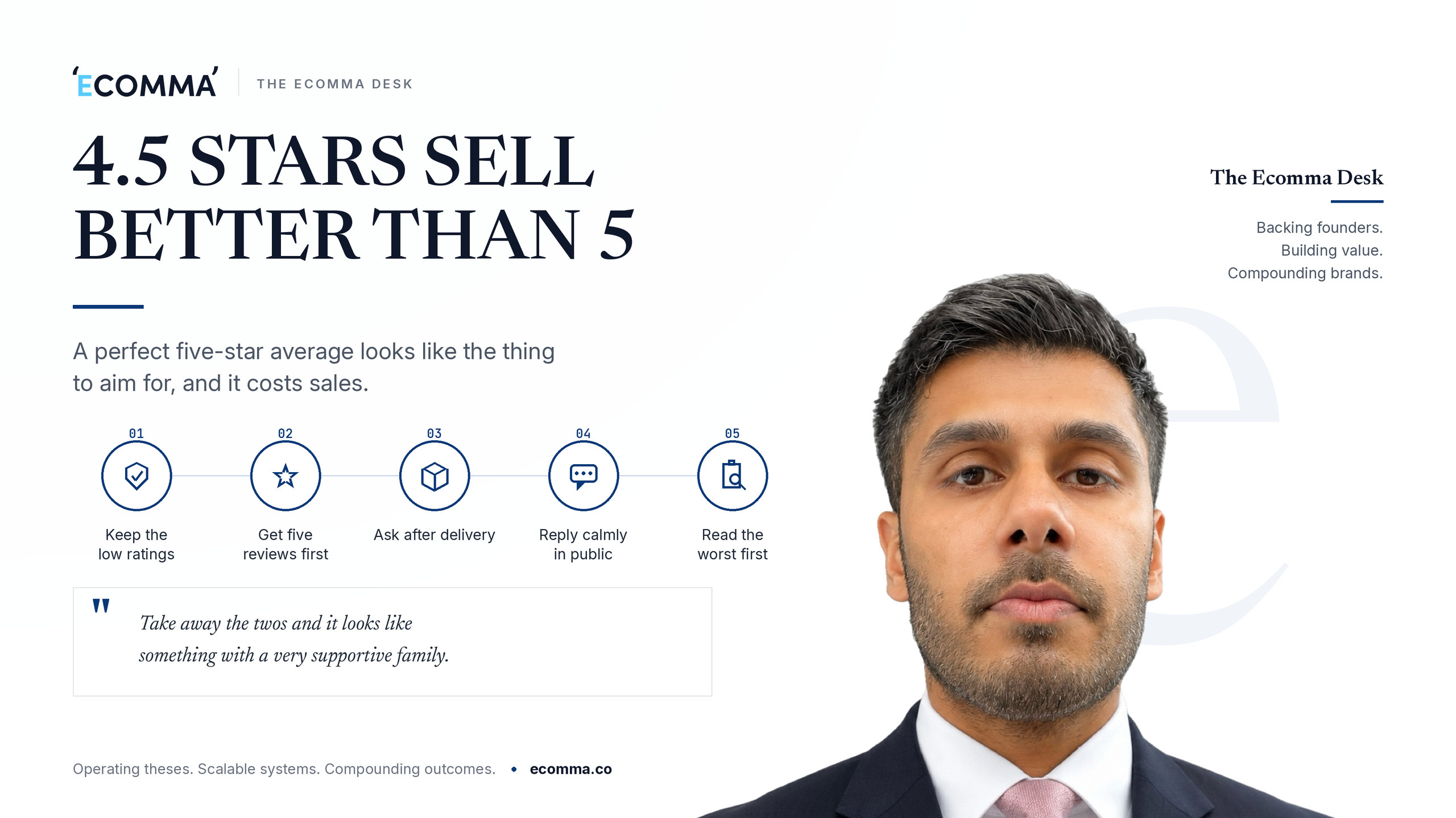
Shoppers are more likely to buy a 4.5-star product than a 5-star one
Why a few low ratings help a product sell, and which reviews a buyer should read first.
A perfect five-star average looks like the thing to aim for, and it costs sales.
Researchers at Northwestern University's Spiegel Research Center found that shoppers are most likely to buy a product rated between 4.0 and 4.7 stars, and that the closer an average gets to 5.0, the less likely they are to buy it. You already know why. Read a job reference that calls the candidate flawless in every respect and you don't picture a flawless candidate. You picture whoever wrote it, and you start wondering how they're related.
Shoppers read reviews the same way. An earlier Spiegel study of PowerReviews data from consumer goods put the peak between 4.2 and 4.5 stars, and the researchers put it down to a perfect score reading as too good to be true.
A few bad reviews make the good ones believable
Low ratings do a job that a page of five-star reviews can't. They prove the reviews are real. A product with 40 five-star reviews and a handful of twos looks like something people actually bought and had opinions about.
Take away the twos and it looks like something with a very supportive family.
Shoppers also go looking for the bad ones on purpose. A PowerReviews survey found that the share of people who seek out negative reviews climbs with how much they spend online, from 57% of those spending up to $250 a month to 71% of those spending more than $1,000. PowerReviews' explanation is plain. Negative reviews “assure consumers they can live with worst-case scenarios.”
If the worst anyone can say about a lamp is that it arrived a day late, the lamp is in good shape. A one-star review complaining that a candle smells too much like candle is doing the candle a favour.
So deleting the twos to keep a perfect score is a bad trade, and in the US it's now a legal risk as well. In August 2024 the Federal Trade Commission announced a rule that bans businesses from using unfounded legal threats or intimidation to stop or remove a negative review. The same rule bans presenting the reviews on a site as all or most of what customers submitted when some have been suppressed, and the FTC can seek civil penalties from knowing violators.
Five reviews matter more than a perfect score
Before any of this counts, a product needs reviews at all. The 2017 Spiegel report found that a product with five reviews is 270% more likely to be bought than one with none, and the effect was bigger on expensive products: showing reviews lifted conversion by 190% on lower-priced items and by 380% on higher-priced ones.
Get the first five reviews on the products that sell, and only then think about the average.
A store that spends its week defending a 4.9 on its bestseller while half its range sits at zero reviews has its priorities the wrong way round. Ask each customer for a review once the parcel has arrived and they've had a chance to use what they bought. Asking the moment the card is charged gets you reviews of the checkout.
When a bad review comes in, reply in public, briefly and without arguing. Shoppers keep reading a calm reply long after the customer who wrote the review has moved on.
A buyer learns more from a store's worst reviews than from its average
For anyone buying an ecommerce business, the average on a product page is the least useful number on it.
A 4.6 across 400 reviews tells you more than a 5.0 across nine, because only one of those numbers has been tested by strangers. Read the low reviews before the high ones, the way the big spenders do. Complaints about a late courier are an operations problem with a known fix. Complaints that the product broke within a week are a conversation to have with the supplier before you sign anything.
Then check the dates. Reviews that keep arriving month after month mean the store asks for them, usually in an automated email sent after delivery. That email keeps sending after the business changes hands, so it's one of the few pieces of a store's marketing that carries on whoever owns it.
Shoppers believe a 4.6 and squint at a 5.0. Leave the twos where they are.
Sources
Spiegel Research Center, Northwestern University. How Online Reviews Influence Sales, 2017.
Spiegel Research Center, Northwestern University. Spiegel research reveals 4.5 stars are better than 5, 2015.
PowerReviews. The Ever-Growing Power of Reviews, 2021, as cited in 3 reasons negative reviews aren't so spooky.
US Federal Trade Commission. Federal Trade Commission Announces Final Rule Banning Fake Reviews and Testimonials, 14 August 2024.