
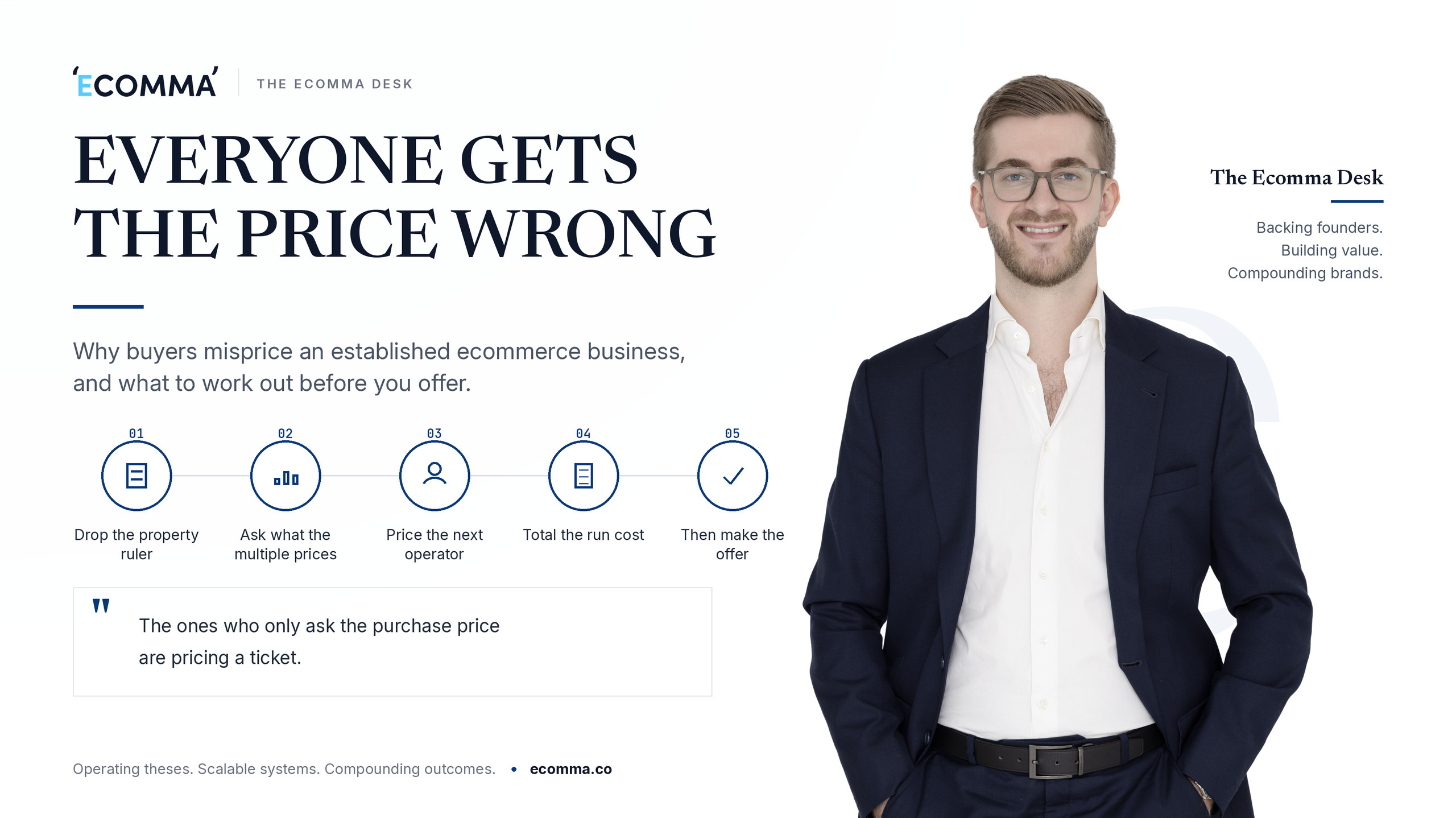
Everyone Gets the Price Wrong
Why buyers misprice an established ecommerce business, and what to work out before you offer.
I've sat across the table from a few hundred people while they found out what an established ecommerce business actually costs. Two reactions come back at me and they point in opposite directions.
Most think it's expensive. They come back twenty-five to forty percent under the asking price. The rest look at the same number and get suspicious. Two times annual profit, and they start hunting for what's wrong with it.
Both of them are pricing the business against something they already own, and neither of those things behaves like this one.
I'll admit my own part in this. For my first year here I argued with the lowballers. I'd walk them through the numbers again, only slower, as if the problem was that they hadn't heard me the first time. It never once worked. A man who opens at forty percent under hasn't misheard you. He's told you he doesn't know what he's looking at, and no amount of repeating the P&L fixes that.
The lowball comes from property
Almost everyone who sits down with me owns property. It's the asset they learned on, so it's the ruler they bring.
Property has a floor you can stand on. Tenants leave and rents drop twenty percent. Somebody puts a tower in front of your sea view. On the worst day of your life it's still a building on a plot. That floor is what makes a low offer feel safe. Underpay on an apartment in Marina and you still own an apartment in Marina.
So the instinct is to anchor low and wait. On property that works, because the thing keeps existing while you negotiate.
An operating business doesn't wait for you. The purchase order has to reach the factory by the twentieth or the container misses the sailing, and forty-five days at sea means the restock lands in November for a September season. A Klaviyo flow stops sending the morning somebody's card expires, and that's eight percent of revenue gone until a human notices. Cost per acquisition on Meta drifts from $30 in January to $50 by June with nobody doing anything wrong.
I had a buyer spend nine weeks grinding a hundred and twenty thousand off a nightwear brand. He was right that it was overpriced, and I should have said so in week one instead of defending a number I didn't believe. By the time he signed, the brand had missed a restock and run two SKUs dry through October. He got his discount and he bought a smaller business, and both of us had a hand in that.
The suspicion comes from the multiple
The other group does the arithmetic and stops.
Say a brand clears $200,000 a year and the ask is $600,000. Three times. Last year the same buyer looked at a restaurant. That owner wanted six times, and the dental practice his broker sent over was asking eight. So he decides the ecommerce business must be broken.
It isn't. The multiple's lower because the risk sits somewhere else. A restaurant's earnings are pinned to a lease and a postcode, and a twenty-year lease doesn't move. This brand's earnings are pinned to one factory in Guangdong and one ad account. Add a returns rate that can go from nine percent to fourteen because a supplier changed a fabric weight. All of it moves in a quarter.
That's the whole answer and it's a dull one. Nobody's hiding anything from you. You're being offered a business whose earnings track whatever its operator does, and it's priced that way.
The number depends on who runs it next
You're not buying last year's profit. That's already happened, to somebody else, under somebody else's management.
I've seen a brand listed at six hundred and fifty thousand and carried near nine hundred a year later, and the market hadn't moved. Somebody'd run it properly in between. Supplier terms went from thirty days to sixty, which is roughly forty thousand of working capital handed straight back. The returns rate came down four points after a size guide got rewritten. Paid spend came off one channel and onto two. The listing photos looked much the same. The business didn't.
It runs the other way too, and buyers hardly ever price that side. A brand that earned $180,000 last year under a founder who answered supplier emails at eleven at night, who knew which of her sixty SKUs went quiet each March, won't earn $180,000 under an owner who opens the Shopify dashboard on Sundays. Same P&L, different next year.
Here's the part I'd argue with anyone about. Most listings are described as if the earnings are a property of the business. They're not. They're a property of the business plus whoever's been running it, and the second half walks out the door at closing. Every seller knows this and almost none of them say it out loud, because it makes the number harder to defend.
So when somebody asks me what a business is worth, my answer is that it depends who's about to own it. That sounds like a dodge. It's the most useful thing to understand before you make an offer.
The buyers I'm confident about ask what it costs to run
They don't ask what the business costs. They ask what the next purchase order is and when it's got to be placed. What the ad spend has to be to hold current revenue, and whether that's $8,000 a month or $20,000. Who answers the customer emails now, and whether that's a person in Manila at nine hundred a month or the founder's wife for free. How many days there are between wiring the factory and getting paid by the customer.
That last one is working capital. On a brand turning over $600,000 a year you might need sixty to eighty thousand sitting behind it just to keep stock on the water, and more if the factory wants thirty percent up front. Nobody puts that on a listing. When a buyer raises it unprompted I know he's owned something before, and I know roughly how the next eight weeks'll go.
The ones who only ask the purchase price are pricing a ticket.
I'd rather deal with the second group than the first, incidentally, and that surprised me. A buyer who asks awkward questions about working capital in the first meeting is not a difficult buyer. He's a buyer who's going to close. The pleasant ones who agree with everything and ask nothing are the ones who disappear in week six.
What I'd tell you before you offer
Stop anchoring against property. Wrong ruler, and nine weeks of haggling costs more than the discount.
Stop reading a low multiple as evidence of a problem. Ask what it's pricing and make somebody give you a real answer, and if they can't, that's your answer.
Then, before you offer, work out what the business needs from you in year one. The cash behind the stock. The hours. Whoever you end up paying to do the parts you won't. Put that number beside the asking price and look at the two together. Most people never do this, and it's the single cheapest hour of work available to a buyer.
One last thing, because it's the error I see most in people who've done well elsewhere. Being the smartest man in the room about property, or about the company you built yourself, doesn't carry over. It's what makes a capable buyer offer forty percent under on a business that would have paid for itself inside four years, and what makes another walk away from a fair price because it looked too easy.
We have a saying in Finland that the deal isn't closed until you've drunk away the commission. I've had eight-week deals and I've had eight-month ones, and the difference was almost never the price. It was whether the buyer worked out what he was buying before he argued about the number.
Ask what it costs to run. Then make the offer.