Look at the Machine
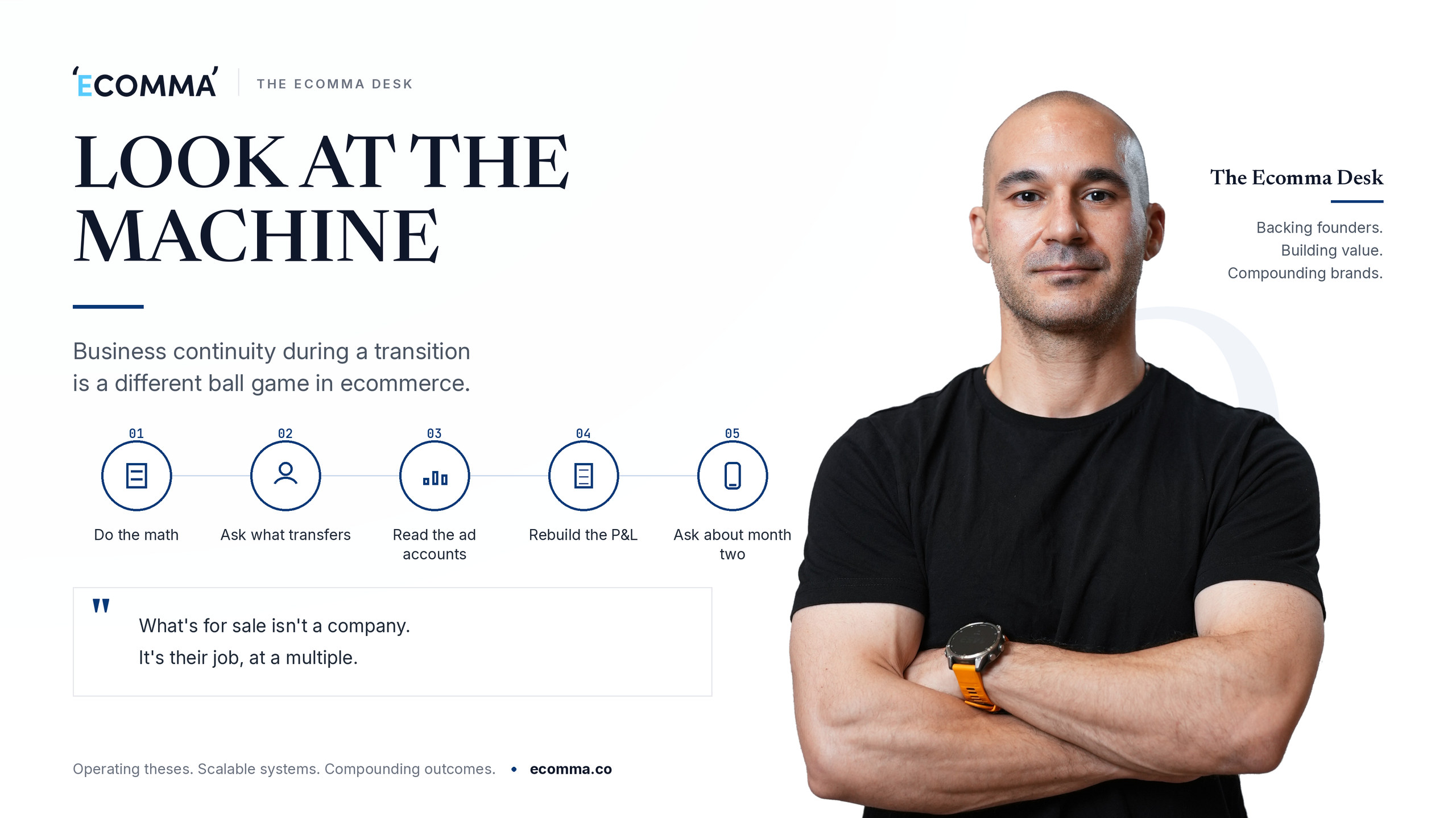
Business continuity during a transition is a different ball game in ecommerce.
A few months into my private equity journey, and I'm deluded enough to think I've learned enough to opine on something as tricky as business continuity. This is what I would tell a younger Wassim (three months younger, to be exact) as he first walked through the Ecomma doors.
Some basic math first
Established ecommerce businesses trade at roughly three to four times annual profit. So half a million buys you something earning $125,000 to $165,000 a year. That's around $10,000 to $14,000 a month, and that's before you pay anyone to run it.
Write it down before you read another listing.
You're buying whatever's left when the owner leaves
Every listing describes a business with its founder still inside it. The founder answers the supplier emails. Knows which of their sixty SKUs goes quiet each March. Has a guy in Shenzhen who picks up on a Sunday. Then they sell, and most of that walks out with them.
So the question isn't last year's earnings. It's what the business earns on a Tuesday when that person isn't in the room. Ask them to walk you through a normal week. If they do forty small things and none are written down, what's for sale isn't a company. It's their job, at a multiple.
Check whether it runs on Google or on Meta
A few minutes in the ad accounts can tell you more than the P&L.
Google is mostly people already looking. Nobody types your product into a search bar unless they want it. Heavy Google traffic can weave a nice story about existing category demand and where the brand stands against its competitors. Sixty percent of revenue through Google tells you the category has real demand and the brand beats everyone bidding on the same words.
Meta is interruption, and interruption gets expensive. A CAC of $30 in January can be $50 by June with nobody doing anything wrong. We spend well into seven figures a year there, so this isn't a complaint. But ninety percent of revenue on Meta might be a great ad account bolted onto an average brand. Buy it and you've bought the ad account.
Neither disqualifies anything. They change what you're paying for.
The books will be a mess. That's fine.
I've lost count of the businesses where the numbers sat across a Shopify export, three bank accounts in two currencies, a spreadsheet the bookkeeper abandoned in October, and the owner's memory. Rebuilding a real P&L means twenty-four months of Shopify or Magento orders, the Stripe and PayPal payouts, the bank statements, the supplier invoices, and the spend out of Google and Meta, all six agreeing. Annoying? Yes. Worrying? Not by itself.
What should worry you, however, is a seller who can't explain their own numbers. Not filed badly. Genuinely doesn't know why gross margin went from sixty-two percent to fifty-five between March and June. Messy books are admin. A founder who doesn't understand their unit economics is telling you nobody's been steering the ship.
Ask their return rate. If they say nine percent without opening anything, name the two SKUs causing it, and mention it ran at fourteen percent before they rewrote the size guide, that's a good sign about everything else. Give me those messy books, and let's work it out.
Nobody tells you the offer comes before the diligence
This confused me the first time, and I do this for a living.
The letter of intent comes first. You offer on a business you haven't examined, and only then do they open the books. Feels backwards. It isn't. No serious founder hands their financial history to a stranger who hasn't signalled they're serious. The LOI buys the right to look.
Price it knowing it'll move.
Ask what happens in month two
Everyone sells you the handover. Thirty days of calls, a shared document, the supplier introductions, an LLC and a Stripe account changing hands. Fine.
Month two is where it goes wrong. Klaviyo stops syncing, the supplier raises unit cost eight percent, Meta disapproves the account, and the previous owner is on a beach in Bali answering every third email.
So ask who picks up the phone in month two. Then month eight. Then what that costs a month. If they get vague, you've found the edge of what's actually on offer.
One more, at my own expense
Before I interviewed here, I spent some time on the Ecomma website. I wasn't a fan. I couldn't work out where I'd go if I was buying, or where I'd go if I was selling. Case studies in the top nav. A blog. Something about courses. A Shopify logo. I couldn't tell whether I was looking at a private equity firm or a marketing agency, and I was about to interview to run its marketing.
The website has changed since then. But the lesson stuck, and it applies to every business we shortlist to acquire: polish tells you almost nothing about the machine underneath. Some businesses look scrappy and run beautifully. Others look immaculate and fall over the week the founder leaves.
Look at the machine. Ask the boring questions. Find out what happens on that quiet Tuesday after everyone who built it has gone.
If you want a second pair of eyes on something you're looking at, or you just want to argue with any of this, email me at wassim@ecomma.co.