
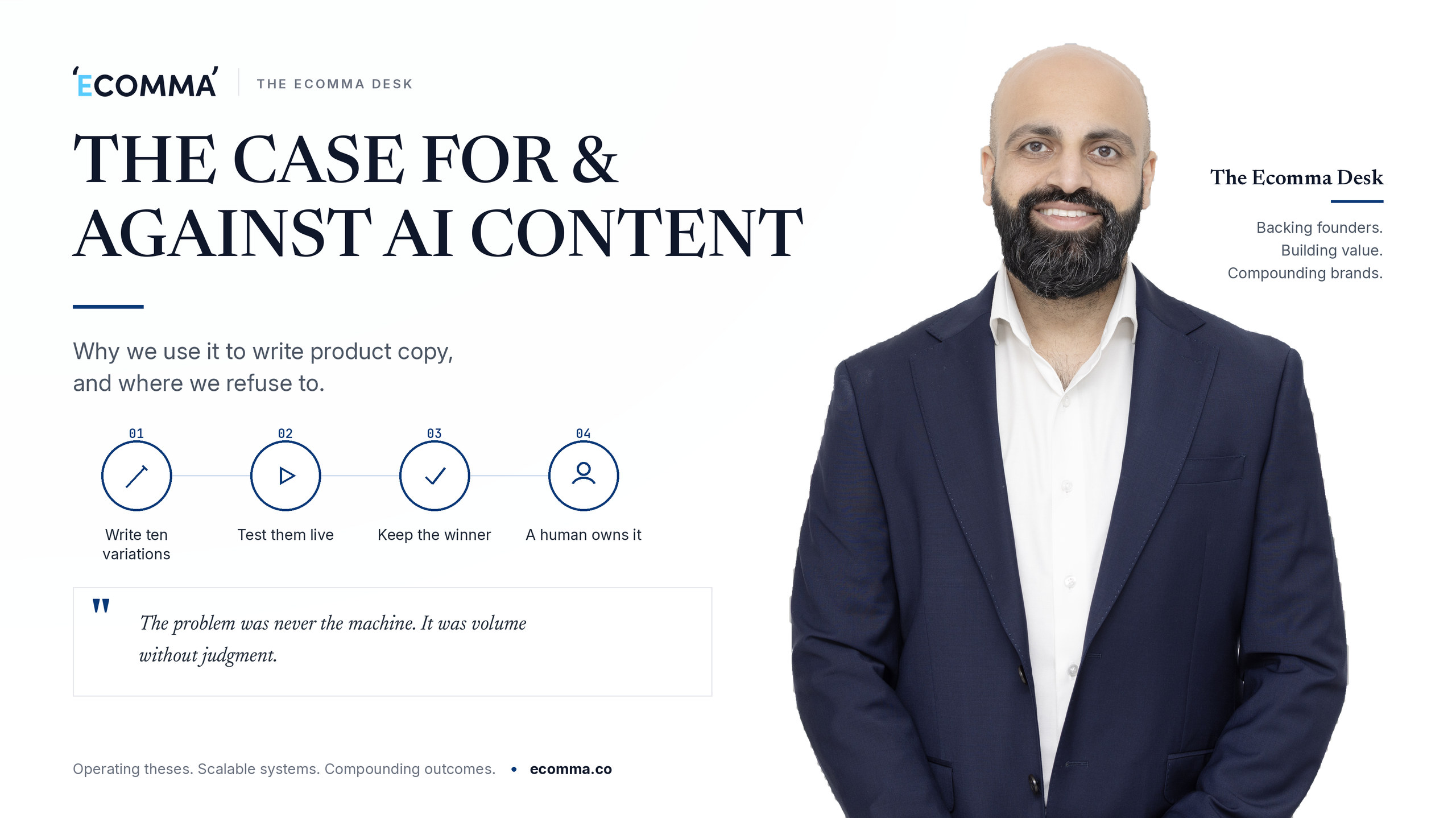
The case for and against AI content
Why we use AI to write product copy, and where we refuse to.
Most people in ecommerce have decided that AI-written content is a problem, and they are not wrong to be suspicious. The web is filling up with descriptions that read like they were stamped out by a machine that never saw the product, because that is exactly what happened. So when a brand admits it uses AI to write copy, a wince is the reasonable reaction.
We use AI to write product copy, and we want to make the case for it anyway, because the wince is aimed at the wrong thing.
The problem was never the machine
The problem was never that a machine helped write the words. The problem is volume without judgment: publishing whatever the model returns, at scale, with nobody accountable for whether it is true, on-brand, or worth reading. That produces slop. But the same technology, pointed differently, does something a human team simply cannot do by hand.
Where AI earns its place: product descriptions
Take one job every ecommerce operator knows is broken: product descriptions. A mid-sized catalog has thousands of them. Most were written once, years ago, by whoever had time, and never touched again. Nobody knows which ones actually help a shopper decide to buy, because nobody has ever tested them. There was never enough writing capacity to try.
This is where AI earns its place. We can write ten different descriptions for a single product, each taking a different angle: one that leads on the material, one on the use case, one on the objection a hesitant buyer is holding back. We put them live, measure which one sells, and keep it. Then we do it again on the next thousand products. That is thousands of controlled variations a month, on a surface that directly moves revenue, tested against real shoppers instead of argued about in a meeting. No human content team has the hours for that.
The discipline matters more than the model
The scale is the gift, but it is also the danger, which is why the discipline matters more than the model. Every variation still passes a brand-voice layer so it sounds like us and not like the internet's average. Every claim gets checked against the actual product data, because a confident sentence about a spec that does not exist is worse than no sentence at all. And a person owns the result: the AI drafts and tests at a scale we could never staff, but a human decides what is allowed to represent the brand. Remove that layer and you are back to slop, only faster.
So the defensible position is narrower than either camp wants it to be. AI content used carelessly is exactly the problem its critics say it is. AI content used with judgment, on the high-volume, testable surfaces where human writing was never going to reach, is one of the few real advantages an ecommerce brand can pick up right now.
Knowing where it belongs
The brands that win the next few years will not be the ones that refused to touch it, or the ones that dumped it everywhere. They will be the ones that know where it belongs and stay disciplined about the rest. That is the line we try to hold. If you are working out where it sits for your own catalog, Idris reads every message at idris@ecomma.co.